Safe. Reliable. Certified.
Service Level Agreement (SLA)
Reliable IT services for business, administration, and critical infrastructure operators

Custom SLA models

Compliance with data protection regulations

Backup and recovery plans

IT support for critical infrastructures

IT emergency management

Proactive system monitoring

GDPR & compliance compliant

100% in-house

Reliable IT operations for businesses and government agencies
IT infrastructures form the backbone of modern organizations. TenMedia's customized IT service level agreements (SLAs) offer measurable service quality, contractually guaranteed services, and full transparency. They guarantee smooth and reliable IT operations for companies and public authorities. With customized and clear implementation concepts, we support organizations in smoothly transitioning to a new SLA model in a practical, efficient, and understandable way.
Modern IT service management begins with a conversation. Request a customized SLA now and gain planning security. Direct consultation with our experts, with no obligation and personalized!
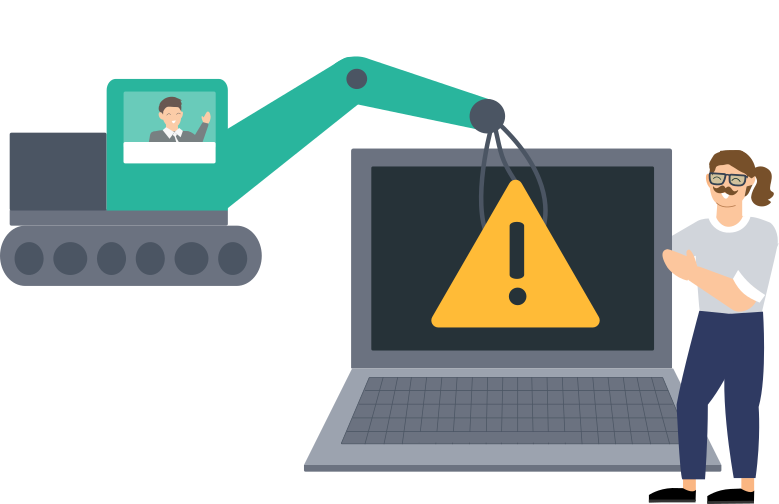
Reduction of downtime
What happens when critical business processes come to a standstill due to unplanned IT failures? High availability of IT infrastructure in production and retail, short response times in the event of public service failures: when critical applications fail, every minute counts. A precisely defined IT service level agreement ensures reliable processes and significantly reduces the risk of costly downtime.
In addition to individual SLAs, TenMedia also supports organizations with comprehensive maintenance and support services for applications and digital infrastructures.
Customized SLAs for specific requirements
In government agencies and companies with high standards for data protection and reliability, blanket SLAs are rarely sufficient. Different organizational structures and risks require customized IT service agreements: They define exactly which services must be available when and how, and make no compromises in incident management. This is based on flexible SLA models that reflect all the special features of modern organizations and make IT services measurable.
-


Cost and planning reliability
Our service level agreements prevent unpleasant surprises by establishing clear financial conditions. Companies and public authorities benefit from reliable cost calculations for IT services and transparent SLA models. Our outsourcing contracts make long-term IT investments predictable and ensure security for all IT expenditures. -


Dedicated contact persons & 100% in-house
Dedicated contact persons accompany every project, from onboarding to acceptance. Personal support instead of a service hotline: All services are provided exclusively by permanent in-house employees. No outsourcing, no external service providers. For us, this is a decisive factor in terms of data protection and trust. -


Guaranteed response times
Whether it's a critical malfunction or a routine inquiry, our customized SLA models guarantee binding response times through clear agreements in the IT support contract. In this way, our service level agreements ensure a reliable response chain in incident management, specially tailored to the business-critical requirements of our customers. -


Proactive system monitoring
Proactive error detection and modern performance monitoring are core components of our service level management. Automated status reports and continuous system monitoring enable potential risks and problems to be identified at an early stage. This effectively ensures high availability of all systems in ongoing IT operations. -


Data protection & compliance
Organizations benefit from legally compliant processes and comprehensive protection of sensitive data. TenMedia's IT services strictly adhere to legal requirements such as the GDPR and industry-specific compliance. Our SLAs meet the highest quality standards, as documented by our TÜV certification according to the ISO 9001 standard.
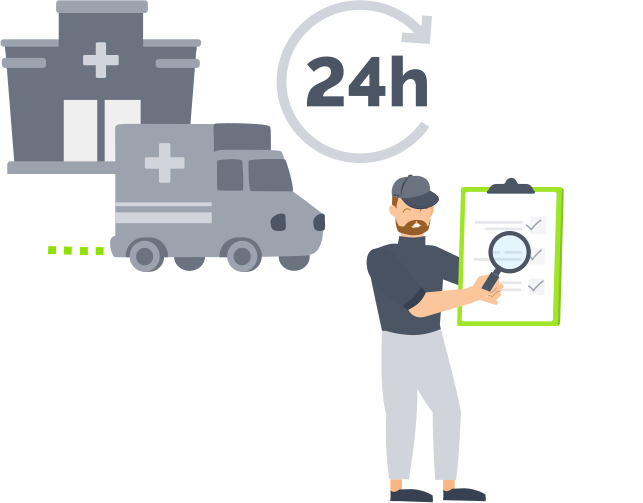
Who are SLAs suitable for?
Service level agreements are particularly suitable for organizations and companies that need to ensure high availability and security for their IT infrastructure. This includes not only critical infrastructure operators and public authorities, but also companies in the manufacturing, retail, healthcare, and financial sectors, for example.
Those who rely on complex service processes, critical applications, or special compliance requirements benefit from structured agreements on service levels, clear ITIL standards, and measurable KPIs. Managed IT services can thus be secured in a targeted manner and controlled flexibly. SLAs are also recommended as the basis for modern digitalization when continuous development and legally compliant support are of central importance.
You can find detailed information about the services we offer in the areas of development, optimization, and IT maintenance here: Our services.
What sets our service level agreements apart?
IT emergency management
Structured processes for IT emergencies are clearly defined in every SLA. Defined escalation chains and proven response mechanisms ensure that our incident management functions seamlessly in accordance with ITIL guidelines.
Minimal time loss, protection against consequential damage, and reliably documented processes ensure maximum planning reliability.
High availability solutions
Fail-safe systems and intelligent emergency concepts guarantee the constant availability of business-critical applications.
High-availability solutions within the scope of our IT service level agreements include regular test runs and preventive maintenance. This ensures systematic protection against failures in even the most demanding IT systems.
Flexible service packages & service hours
Whether classic business hours, 24/7 operation, or support at individual times: flexible service packages enable all IT services to be tailored to specific needs.
Different service hours make IT support scalable, efficient, and cost-transparent for organizations of all sizes. This is especially true for operators of critical infrastructure.
Performance monitoring
Continuous monitoring of system performance and resource consumption forms the foundation of our IT service management. With the help of automated analysis tools, we identify bottlenecks, errors, and anomalies in real time.
Early tracking enables targeted evaluation and ensures long-term reliability and performance optimization.
IT security management
Comprehensive security concepts, regular penetration tests, and continuous risk assessment protect sensitive data and systems. We actively monitor the threat situation and provide recommendations for action.
Our security solutions are customizable and can be flexibly integrated into existing IT structures and business processes.
Transparent reports & KPIs
Our Microsoft DevOps-based ticket system provides transparent tracking of project status and tasks. Every step is documented in real time, and new requests can be entered and monitored independently by the customer.
Individual KPIs provide a clear overview of the qualitative and temporal achievement of objectives for all IT service processes.
Service-oriented IT architecture
Modern, service-oriented IT architectures form the basis for tailor-made digitization measures. Modular structures, standardized interfaces, and cloud-enabled components enable rapid implementation of new services.
Companies and public authorities thus benefit from flexible scalability and optimized business processes.
Integration capability & interface management
Modern IT solutions impress with their integration capabilities and professional interface management.
Open standards, APIs, and secure connection paths enable easy connection of external systems, cloud-based tools, and industry solutions. This ensures consistent digital processes, high flexibility, and high efficiency in daily operations.
Technical lifecycle management
We support the entire life cycle of IT systems and applications: from implementation and maintenance to updates and controlled phase-out. Maintenance intervals and support services are documented in detail.
This forms the basis for a consistently high-performance IT infrastructure and secure software management.
How is the transition from the previous support model to an SLA-based model going?
The transition from traditional IT support to an advanced SLA-based model follows a structured process:

Analysis of the existing IT infrastructure
First, a detailed analysis of the existing IT infrastructure and all previous services is carried out. Then, specific requirements, critical systems, and relevant service classes are defined together with those responsible.
Establishment of individual service agreements
On this basis, an individual IT service level agreement is created with transparent services, clear response times, and measurable KPIs, for example according to ITIL service level management standards.

Integration of services according to the new SLA model
Following the contract-based coordination, the operational takeover begins: The new service concept is seamlessly integrated and transferred to productive operation. Continuous optimization and documentation of all service processes ensure efficient support and maximum availability of IT systems in the long term.
FAQs
Are SLAs also relevant for small and medium-sized enterprises? keyboard_arrow_down keyboard_arrow_up
Yes, an IT service level agreement is also relevant for small and medium-sized enterprises. SLAs establish clear regulations for response times, support, and service level management, secure IT operations, and provide planning reliability, regardless of the size of the company.
How are meaningful service levels and KPIs defined in the SLA? keyboard_arrow_down keyboard_arrow_up
Meaningful service levels and KPIs are defined in an IT service level agreement together with the customer. At the outset, an analysis of individual requirements and business-critical processes is carried out. Typical service levels include response times, availability, incident management, and troubleshooting times, tailored to the respective IT infrastructure. The KPIs then serve as measurable indicators of service quality and are reviewed regularly. Best practices from ITIL Service Level Management help to set standards and make the content of SLAs comprehensible and transparent.
How is compliance with the service quality specified in the SLA monitored? keyboard_arrow_down keyboard_arrow_up
Compliance with the service quality defined in the IT Service Level Agreement is continuously monitored using monitoring systems and regular reports. Automated performance monitoring records all relevant key figures in real time. As part of service level management, a ticket system transparently documents all service requests, incidents, and response times. Individual SLA content and KPIs are recorded in reports and evaluated together with the customer. Deviations are identified promptly and can be remedied in a targeted manner to maintain the agreed quality and reliability on a permanent basis.
How often should an SLA be reviewed and adjusted? keyboard_arrow_down keyboard_arrow_up
An IT service level agreement should be reviewed at least once a year and adjusted as necessary. Changes in IT infrastructure, business processes, or legal requirements make flexible updates to SLA content and KPIs within the framework of service level management advisable.
How do SLAs differ across the various managed IT services? keyboard_arrow_down keyboard_arrow_up
Service level agreements differ depending on the type of managed IT services in terms of individual content, service levels, and KPIs. While software maintenance contracts often focus on regular updates and troubleshooting, SLAs for managed IT services such as IT support or cloud services regulate specific response times, availability, and support levels. Industry-specific requirements and outsourcing contracts with service level agreements may also include different priorities, service times, and reporting obligations. This allows the SLA to be tailored precisely to the respective IT area and specific customer needs.
Can maintenance contracts be concluded for software developed elsewhere? keyboard_arrow_down keyboard_arrow_up
Yes. We also take over the maintenance and support of software that was not developed by us. After an initial code audit and onboarding phase, we integrate the project into our processes, including monitoring, support and further development.