Relief through AI
German authorities are under pressure: the critical-infrastructure regulation, the skills shortage and OZG obligations allow no delay.
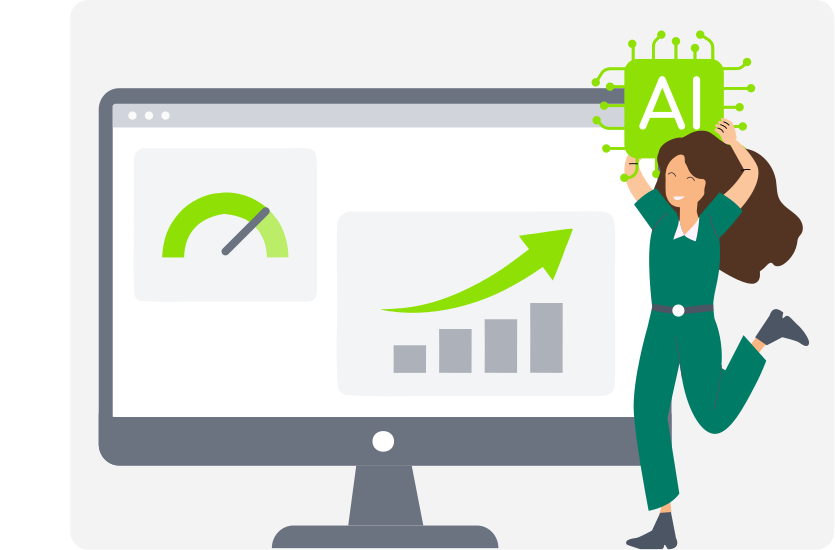
AI provides tangible relief for decision-makers and staff, but only if it runs sovereign and is documented in a traceable way. This is where the AI Regulation (EU AI Act) applies.
TenMedia integrates AI for public administration and offers seamless maintenance services via SLA. On request for the entire software landscape.
Legally compliant by design
AI integration for authorities and critical infrastructure is subject to several frameworks: the AI Regulation (AI Act), data protection, accessibility and IT security. TenMedia covers all four technically, with concrete measures.
Account for and adapt to the AI Act
Human oversight, logging, transparency: taking the AI Regulation into account, we build the necessary obligations directly in. Changes are adapted dynamically during maintenance.
Protect personal data
A data-protection-compliant AI masks personal data before every model call and observes federal and state data protection, so AI for public administration remains verifiable in data-protection terms.
Accessibility under BITV
We develop citizen interfaces accessible from the outset in line with BITV 2.0 and WCAG, easy language included. Even with every update, digital accessibility is preserved.
Security under BSI baseline protection and ISO 27001
Logging and audit trails align with BSI baseline protection. The framework is set by TenMedia's ISO-27001-certified information security as evidence of ongoing cybersecurity optimisation.
How AI optimises administrative processes
Scarce staff and high compliance requirements: four pressures shape administrative digitalisation, and each one points to a plannable next step for AI integration.
OZG 2.0 is mandatory, yet implementation is stalling: in 2025 only nine fully digital services were added nationwide. Applications pile up while staff are missing. AI in application processing takes over the routine and frees up time for the actual specialist decision.
With every retirement, experience and file knowledge leave the authority. AI-supported knowledge and file retrieval (RAG) makes this knowledge searchable and delivers sourced answers, so cases remain traceable even after a change of staff.
Running AI via US cloud services means relinquishing control over data and availability. EU-hosted AI with open models secures digital sovereignty and keeps processing within a legally sound framework.
NIS-2, BSI baseline protection and the AI Act raise the demands on security and verifiability. An architecture that is standards-based from the outset, with audit trails, makes compliance testable instead of bolting it on afterwards.
The EU AI Act at a glance
With the EU AI Act, a Europe-wide, uniform and risk-based framework for artificial intelligence applies for the first time. For authorities this is more than a formality: as operators they are directly obligated, even when the AI comes from a service provider.
The more sustainably an AI is planned to be legally compliant, the smoother the entry.
Impact assessment and prohibitions
Some practices are prohibited in principle, several of them target state action directly, others count as high-risk. Before deploying such systems, the law even requires public bodies to carry out their own impact assessment for citizens' fundamental rights.
AI literacy obligation
Since February 2025 the AI literacy obligation under Article 4 of the AI Act applies: authorities must ensure their staff understand and use AI responsibly. TenMedia trains employees hands-on on their own system and provides impulses for optimal use.

Fields of AI application in public administration
Which fields of AI application in public administration are classified as high-risk by the AI Act under Annex III in accordance with Article 6(2)? The following view puts this into context and shows where administrative digitalisation remains uncritical.
Citizen service & AI chatbots (OZG)
- Answers standard enquiries around the clock, with source references
- Clearly identifiable as AI; complex cases are forwarded to specialist units
Knowledge & file retrieval (RAG)
- Finds answers in seconds instead of hours of searching
- Searches e-file, registers and specialist procedures, with source evidence
OCR & e-file
- Captures and sorts incoming mail automatically
- Transfers everything into the e-file audit-proof, including deadline detection
Specialist procedures & case handling
- Fills in fields and checks plausibility
- Transfers data from documents into the specialist procedure without media breaks
Application review
- AI in application processing checks prerequisites and requests evidence
- Speeds up the preliminary review, every review step stays traceably documented
Social benefits & housing allowance
- Prepares eligibility review and calculation (Annex III AI Act)
- Ensures uniform, equal-treatment calculations and reduces calculation errors
Notice generation
- Drafts documents from case data and legal bases
- Keeps wording and legal references uniform and legally sound
Easy language & translation
- Transfers notices into easy language and foreign languages
- A building block of accessible administration under BITV

AI solutions for authorities and critical infrastructure, two paths, one partner
AI in authorities and LLMs in critical infrastructures follow different logics. TenMedia integrates bespoke AI solutions for administrations as well as for plant protection. Our experience ranges from projects such as the accessible internal directory of the Cologne district government to crisis-management software for the public sector in Berlin. We set our priorities according to the respective requirements.
Public administration
- Relieve specialist procedures with AI without replacing legacy systems
- Speed up citizen service and application review in line with the OZG
- Personal data protected by masking and EU hosting
- Procurement- and EVB-IT-ready as well as accessible under BITV
Critical infrastructure operators
- AI-supported attack detection for critical infrastructure under NIS-2 and BSIG
- Alignment with BSI baseline protection and seamless audit trails
- Resilience and defined service times for ongoing operations
- Scalable authorisation and access-control concepts

From idea to legally compliant operation
An AI project in administration succeeds when risk, procurement and responsibility are clarified early. Five phases lead from the idea to the lasting operation of AI for public administration.
AI readiness and use case
A free initial consultation clarifies which use case is viable, which data is available and which aspects of the AI Act affect the planned AI integration: a solid basis before anything is implemented.
Procurement-ready specification
Effort, architecture and data protection are described in a procurement-memo- and EVB-IT-ready way. Thanks to our AVPQ pre-qualification, suitability is already officially proven, which reduces the review effort of the procurement office.
Testing under real conditions
A clearly defined first use case is built in separate development and production environments and tested under real conditions before it goes live. This shows the concrete benefit before investing in the broad rollout.
Rollout and training
With the go-live we train staff hands-on in the safe use of the new system. Clear roles and responsibilities anchor the required AI literacy permanently in everyday work.
Operation and maintenance
Operation runs over EVB-IT terms with defined service times. Models, knowledge bases and new obligations are continuously updated so that the AI remains operational for years.


FAQs
A custom-built AI solution reflects the specific procedures, data protection requirements and compliance rules of an authority. It can be connected to legacy systems, remains GDPR-compliant in EU hosting and can be classified and documented under the AI Act, instead of having to retrofit a standard solution.
AI relieves above all where routine dominates daily work: citizen service and information (OZG chatbots), knowledge and file retrieval (RAG), OCR and e-file, application review, notice generation and translation into easy language. This leaves more time for the actual specialist decision.
The path runs through five phases: AI readiness and use-case selection, procurement-compliant specification, testing under real conditions, rollout with staff training, and lasting operation with monitoring and maintenance.
Yes, provided the solution is designed to be standards-based from the outset. TenMedia processes personal data through masking and pseudonymisation in EU hosting, classifies applications by AI Act risk class and ensures verifiability through logging and audit trails in line with BSI baseline protection and ISO 27001.

What we are proud of
- Experience
- 15+ Years
- Customers
- 30+
- Availability of maintained systems
- >99,9%
- Projects
- 40+
- In-house development
- 100%
- Ventures
- 4+
- Partner
-

- Certifications
- ISO 9001: Quality Management
ISO 27001: Information Security